
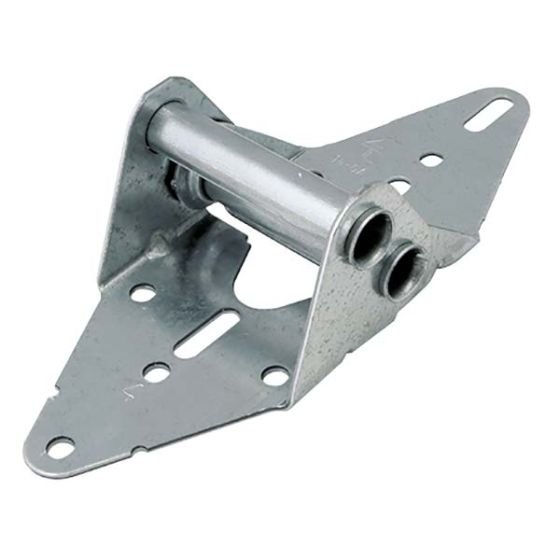
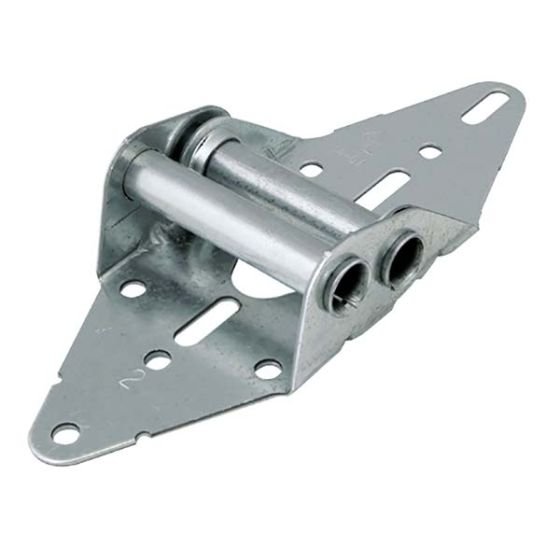
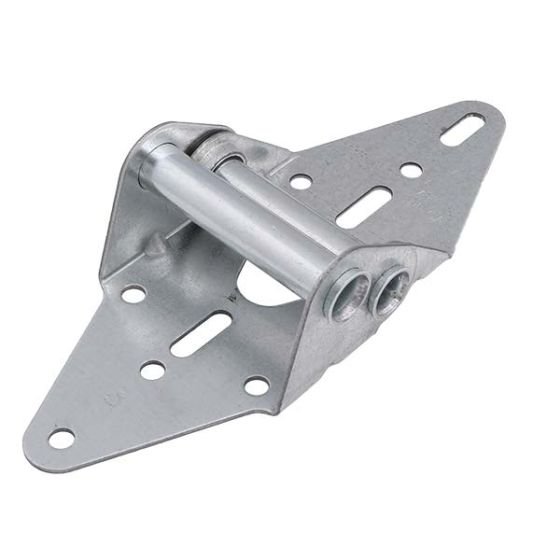
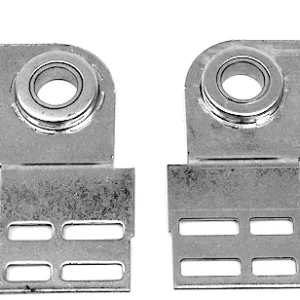
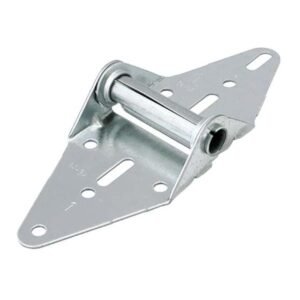
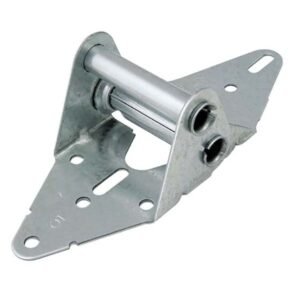
The #3 garage door hinge is a graduated end hinge for residential sectional doors, used one section above the #2. Its roller carrier sits a step further from the door face than a #2, which lets that section follow the angle of the track as the door closes. It is formed from 14 gauge galvanized steel for a rigid, quiet hinge that keeps the roller steady.
Specifications at a Glance
What the Hinge Number Means
A sectional garage door bends around the curve of the track as it opens, so its hinges cannot all be the same. The number stamped on each hinge tells you where it belongs.
Center hinges sit along each seam between the ends of the door, and on most residential doors they are all #1. End hinges sit at the outer edges and hold the rollers. They are graduated: each higher number has a taller roller carrier that holds the roller further from the face of the door, so every section lines up with the angled track and the door closes snugly against the weatherseal.
| Hinge | Type | Typical location |
|---|---|---|
| #1 garage door hinge | Center hinge | Every seam, between the two end hinges |
| #2 garage door hinge | End hinge | Lowest end-hinge position, at the first seam above the bottom section |
| #3 this product | End hinge | One section above the #2 end hinges |
| #4 garage door hinge | End hinge | One section above the #3 end hinges |
| #5 garage door hinge | End hinge | Top end-hinge position on taller doors with more sections |
Door manufacturers do not all number their hinges the same way, and some start the end hinges at #1. The table shows the common pattern, but the number stamped on your old hinge is always the one to match.
Will This Hinge Fit My Door?
Hinges look alike, but the number changes how far the roller sits from the door. Check these before ordering.
- The hinge you are replacing is stamped #3 critical
- Your door is a residential sectional door, not a one-piece tilt-up door critical
- For end hinges, the roller from the old hinge is in good condition, or you are replacing it too
- The mounting holes line up with the old hinge before you remove it
- The door skin around the hinge is not torn or pulled out, so the new screws will hold
Not sure which number you need? Send us a photo of the old hinge and we will confirm it before you order.
How to Find Your Hinge Number
Find the stamp
Look on the flat leaf of the hinge for a small number pressed into the steel, usually near the mounting holes. Wipe off any grime with a rag so you can read it.
Note center or end
If the hinge holds a roller at the outer edge of the door, it is an end hinge. If it sits along the seam between the ends with no roller, it is a center hinge, usually a #1.
Note the seam
For end hinges, count which seam it sits on from the bottom of the door. The left and right end hinges on the same seam share the same number.
Order to match
Order the same number, and replace one hinge at a time with the door closed so the sections stay aligned.
Full Technical Specifications
| Product type | Residential sectional garage door hinge |
|---|---|
| Hinge number | #3 |
| Hinge type | Graduated end hinge with roller carrier |
| Material | 14 gauge galvanized steel |
| Quantity | 1 hinge |
| Typical position | One section above the #2 end hinges |
| Door type | Residential sectional garage doors |
| Category | Garage door hinges |
What’s Included
In the box
- 1 × #3 garage door hinge, 14 gauge galvanized steel
Sold separately
- Rollers, which slide into the roller carrier on end hinges, see garage door rollers
- Other hinge numbers, see all garage door hinges
Safety: Replace One Hinge at a Time, and Leave the Bottom Brackets Alone
Hinges are one of the safer parts of a garage door to replace, but the door around them is heavy and spring-loaded.
- Close the door fully and disconnect the opener before you start.
- Replace one hinge at a time so the sections stay supported and aligned.
- Never loosen the bottom bracket at either lower corner of the door. It is attached to the lift cable and under full spring tension.
- Stop if the section around the hinge is torn or cracked, and have it inspected.
If you are not comfortable working on the door, a garage door technician can replace hinges quickly as part of a tune-up.
Signs a Garage Door Hinge Needs Replacing
A visible crack, usually starting at a screw hole.
The hinge no longer sits flat against the door.
Screws keep backing out, or the holes have stripped.
A section drops or pulls away when the door moves.
Noise at one joint that lubrication does not fix.
The roller tilts, binds or jumps in the track at this joint.
A cracked hinge often points to a door that is out of balance. If several hinges have cracked, have the springs and cables checked too, or the new hinges will crack the same way.
Frequently Asked Questions
What does the #3 on a garage door hinge mean?
The number tells you where the hinge belongs. Center hinges, which join the sections along each seam, are usually all #1. End hinges at the outer edges are graduated: each higher number has a taller roller carrier that holds the roller further from the door. A #3 is an end hinge, one section above the #2 end hinges.
Where does a #3 hinge go on my door?
At the outer edges of the door, one section above the #2 end hinges. As with every end hinge, there is usually one at the left end and one at the right end of the same seam.
How many #3 hinges do I need?
End hinges work in pairs, one at each end of the same seam. If both #3 hinges are worn, order two. Replace them one at a time so the section stays supported.
Can I use a different number if I cannot find a #3?
No. Each number holds the door at a set distance from the track. Fitting the wrong one makes that section sit too close to or too far from the track, so the door rubs, binds or leaves a gap when it closes. Match the number stamped on your old hinge, which is #3 for this product.
Can I replace a garage door hinge myself?
Most hinge replacements are a straightforward job with the door fully closed and the opener disconnected, working one hinge at a time. The exception is the bottom bracket at each lower corner of the door, which is attached to the lift cable and under spring tension. Never loosen those. If a hinge near the bottom of the door is damaged, or the section around it is torn, have a technician look at it.
Do I need to replace all of my hinges at once?
No. Replace the hinges that are cracked, bent or no longer hold their screws. While the door is closed, check the others for cracks around the screw holes. Several cracked hinges usually mean the door is out of balance, so have the springs checked as well.
How are hinges shipped?
Hinges ship by FedEx or can be collected from our Sacramento or Santa Clara store. See our shipping policy for current rates and dispatch times.
Why Choose This #3 Garage Door Hinge
Each step up in hinge number moves the roller a little further from the door, and the #3 is where that offset starts to matter for a tight seal. Matching it exactly keeps the middle of the door lined up with the track.
Match the number stamped on your old hinge before ordering. Contact us with a photo if you would like it checked first, or browse all garage door hinges.
Reviews
There are no reviews yet.